
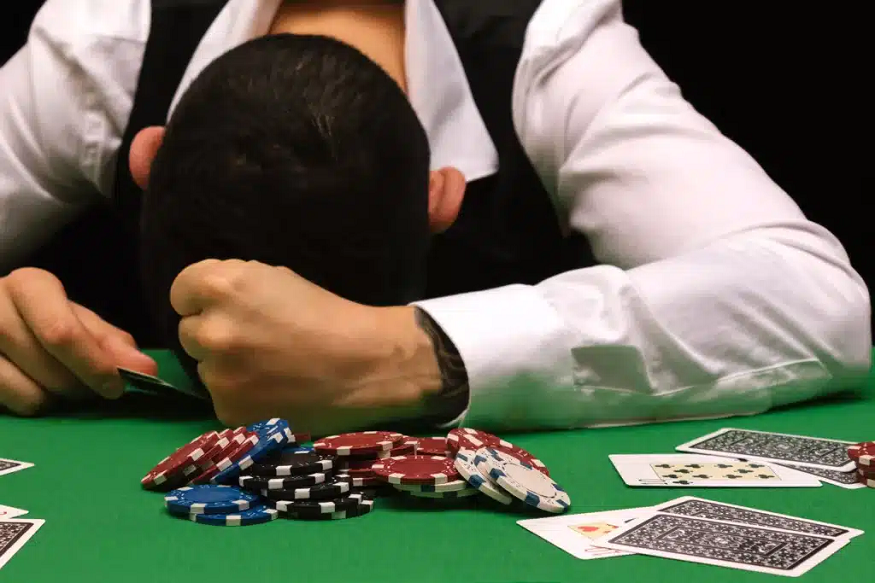
Gambling is a kind of time and financial exhaustion that doesn’t show up on balance sheets or calendars. It’s a hollowed-out existence where the noise only starts once everything else is gone. You feel it in the existential “Time-Debt” that accumulates during active gambling. While most people focus on the bank balance, the more profound loss in addictive gambling is the erosion of presence and agency.
1.The “Time-Theft” Audit: The Hidden ROI of a “Loss Spiral”
In high-performance environments—copywriting, strategy, data analysis—you understand asset allocation. But in a gambling cycle, you aren’t just losing currency; you are experiencing Temporal Asset Stripping. Money is a renewable resource. Time is non-recoverable capital.
The Mechanics of the “Time-Soaker”
Every gambling session functions as a high-interest loan against your professional future. It is the ultimate “time-soaker” because it doesn’t just take the hour you spend betting; it takes the Recovery Time required to regain your focus.
Read More:Behavior Health Addiction: Understanding Care, Treatment, and Long-Term Recovery
- The “Shadow” Hours: For every 60 minutes spent gambling, you lose an additional 120 minutes to “Cognitive Residue”—the inability to switch back into “Deep Work” or strategic thinking.
- Opportunity Cost Analysis: If your billable rate is $100/hour, a 3-hour gambling session isn’t just the amount lost on the screen; it is a $300 baseline deficit before the first bet is even placed.
Run the “Dual-Exposure” Audit
To get help for losing too much money gambling, you must audit your two most volatile ledgers:
- Financial Exposure: The direct withdrawal from your accounts.
- Temporal Displacement: That is the loss of focus and networking to gambling. The billable hours, networking opportunities, and “Deep Work” sessions sacrificed to the “Algorithm.”
The Professional Pivot: Specialists in behavioral finance don’t just track bank statements—they map Time-Equity. They recognize that for a professional, “just one more round” is actually a short-sell on your own career. When you reframe gambling as a “Time-Theft” system, the “edge” you think you have disappears. You aren’t playing against a house; you are paying a 100% tax on your most valuable professional asset.
2. Flow-State Substitution: You Don’t Need Less Intensity—You Need Better Direction
Let’s analyze the paradox;many assume the “gambling zone” isn’t powerful. It is. That’s why it works.But the issue isn’t the state—it’s the structure behind it.
Reactive vs. Generative Engagement: This is the core of Flow Substitution: High-achievers feel a similar “trance” in gambling as they do in their professional work, but with opposite long-term results.
- Gambling: you wait, react, repeat
- High-value flow: you build, adjust, improve
High-sovereignty activities: These represent the ultimate “counter-measure” to the gambling loop. While gambling is a reactive system (where you are a passenger to random chance), high-sovereignty tasks are generative systems (where you are the architect of the outcome). That may include;
- Coding something complex
- Producing music or content
- Designing, writing, solving layered problems
The essence here iscontrol; the quality of the output is directly proportional to your input. Hence, in the right environments, your input shapes the result
Specialized recovery professionals don’t strip away intensity—they reallocate it. The goal isn’t to become passive. It’s to place your focus into systems where time spent creates something tangible, not something that disappears.
3. Boredom as a Strategic Reset (Not a Weakness)
Here’s where most people misread the process: boredom feels like something is wrong. It’s not.
It’s recalibration. Here, understanding core neuro-adaptation settings is crucial:
- Your baseline is distorted: After repeated high stimulation, normal life feels flat—not because it is, but because your system is adjusting
- The discomfort phase: Silence, stillness, slower moments—they feel unfamiliar, even irritating
- What’s actually happening: Your brain is resetting its reward threshold
Experts who work in this field prepare you for this stage—not as something to avoid, but as something to move through with intention. Because on the other side of that reset, clarity returns. Focus returns. Even simple moments regain weight.
4. The Conscious Shift: From Disappearing to Showing Up
The escape cycle thrives on one thing—being mentally somewhere else. It looks like: Always ahead. Always waiting. Never fully here.
Breaking that isn’t about forcing presence. It’s about practicing it with structure.
Read More:Tips To Stay Relaxed In Stressful Situations Without Losing Focus
- Interrupt future-loop thinking: Bring attention back to immediate actions—what you’re doing, not what’s next
- Grounding in real environments: Conversations, physical surroundings, tangible tasks
- Professional integration: Align your schedule so your time is accounted for—not rigidly, but intentionally
This is where the real pivot happens. You’re no longer trying to “escape better”—you’re learning to engage more precisely. And over time, that becomes your new default.
In essence, if you keep treating this as a surface-level habit, you’ll keep missing the deeper shift that needs to happen. This is about reclaiming control over where your time goes—and who you become while spending it. With the right structure and professional insight, what once felt like escape can be replaced with something far more valuable; direction.